

PFP at the World Parkinson’s Congress
Takeaways, connections, and adventures from our week in Phoenix, Arizona
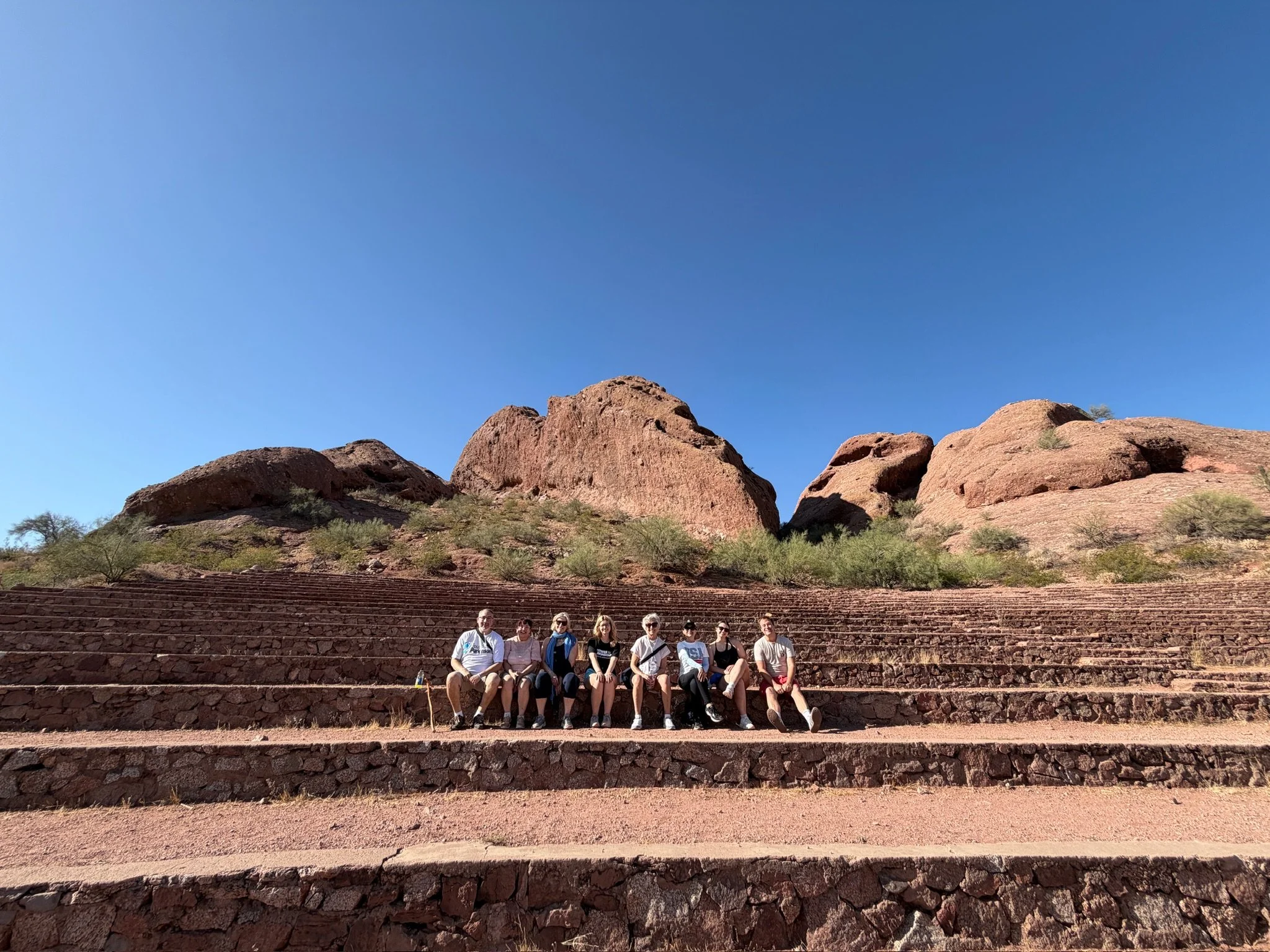
Amongst the giant saguaro cacti and distinctive sandstone formations in Phoenix’s Papago Park, I hiked alongside a new friend: Anne Pearce, who’d traveled from Leeds, England to Arizona for the 7th World Parkinson’s Congress.
“When you’re diagnosed with PD you sort of become a member of a club,” she told me as we strolled through the hilly desert landscape. “It’s not a club that you want to be part of, but then you see that’s a very special community and one that’s very supportive.
For that club, attending the World Parkinson’s Congress is akin to being in Davos, Switzerland for the World Economic Forum. It’s both the brain trust and cultural expo of the Parkinson’s community – attended by neurologists, people with Parkinson’s, researchers, fitness professionals, care partners, physical therapists, and organizers of local PD resources. It’s the kind of event where you might be on the same escalator as a stem cell researcher and a guy with PD who traveled 5,000 miles to improve and inform the weekly support group he hosts in his living room.
This year, taking place in the US for the first time in a decade, the WPC drew nearly 4,000 attendees from 60 counties – with roughly one-quarter of registrants being people with Parkinson’s.
When Roger Barker, a professor of clinical neuroscience at Cambridge – and also President of the board that puts on the WPC – stopped by the Power for Parkinson’s booth to try out some of our brain-body exercises, told me that he sees the place for PhD’s and people with PD to come together.
“For many researchers, they’ve never seen these things called ‘patients,’ in person and seeing that they are people,” he offered. “One thing I can guarantee is everyone will be a patient one day. The best principle in medicine is to treat the patient like you want to be treated yourself and imagine what it’s like on the other side.”
Meanwhile for the people with Parkinson’s, the WPC is a place to empower themselves with information and resources – even if, as many of the lectures confirmed, the future therapies are still years away. As Rebecca Miller, a licensed clinical psychologist representing the Michael J. Fox Foundation, put in while speaking at the event’s opening ceremony: “People can take control of their disease.”
