

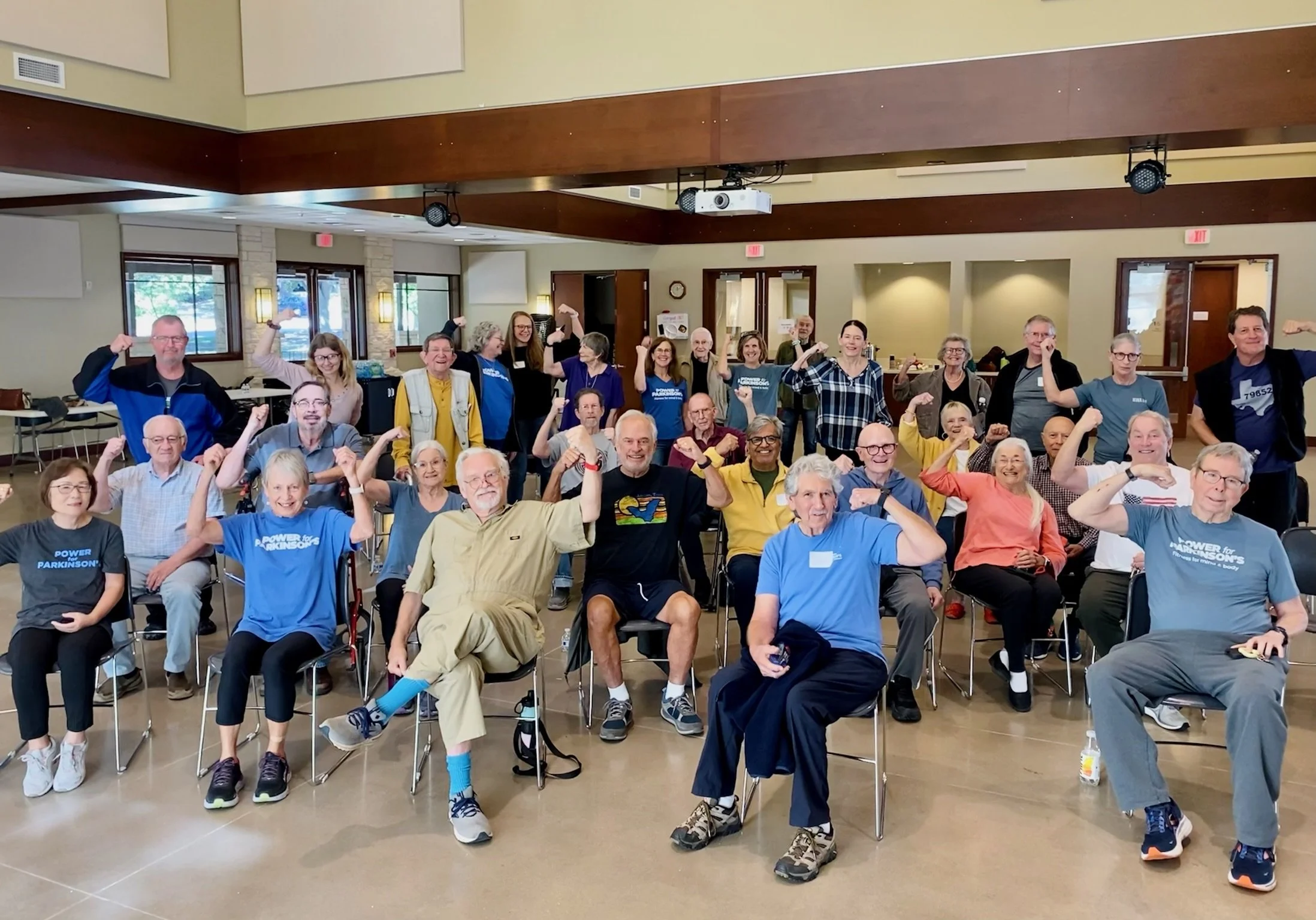
In the Fall of 2022, Power for Parkinson's (PFP) started offering support groups for our participants and their caregivers. Since then, many of our participants have reached out to ask questions about the support groups and what they might expect if they decide to attend. In an effort to make the invitation to attend these groups even more welcoming, this blog post will answer frequently asked questions about PFP Support Groups!
What are support groups?
Support groups are organized opportunities for people with Parkinson’s and their care partners to gather in a community space. They provide a welcoming environment to be vulnerable, offer encouragement, share coping strategies and information, and come together as a community.
Where are the groups held, and who can attend?
PFP’s in person support groups are held at Westminster Presbyterian Church on the third Tuesday of every month from 9:30am to 10:45am. Women with PD will meet in Fellowship Hall, men with PD will meet in the Choir Room, and care partners will meet upstairs in the Youth Room. Volunteers will be happy to show you to the appropriate room.
Whether you’re a regular Power for Parkinson’s participant or you’re just hearing about us now, we would love to have you at our support group meetings! You may come and go as you please, and you’re free to attend at your convenience.
What if I can’t make it to the in-person meetings?
PFP offers a virtual support group meeting where you can join from anywhere in the world! The meeting occurs every third Monday of the month at 10am Central Time (8am PT, 9am MT, 11am ET). This group meets via Zoom to discuss important topics surrounding Parkinson’s, provide emotional support for one another, and build strong connections among PFP participants across states, countries, and continents.
Email claire.eastman@powerforparkinsons.org to receive the Zoom link.
Who facilitates the support groups?
Claire Eastman, PFP’s Community Program Assistant and instructor, facilitates the women’s and virtual support groups. She deeply appreciates the sense of belonging and community that support groups foster, and she is constantly inspired by the vulnerability, hope, and connection within the groups. With a bachelor’s degree in Social Work from UT Austin, Claire uses warm, empathetic, and practical techniques in leading support groups and managing resources. She believes that while everyone is on their own Parkinson’s journey, the power of support groups help make known that no one is navigating this alone. Outside of PFP, Claire loves to stay active, spend time outside, and sing. She hopes you’ll join one of our support groups soon to share your story.
Trent Delomel facilitates PFP’s support group for men with Parkinson’s. Trent became involved with Power for Parkinson’s after his mother-in-law was diagnosed with Parkinson’s and moved in with his family. He has facilitated the Men’s Support Group since 2023, helping members make room for the complexity of living with Parkinson’s: hope and grief, strength and vulnerability, acceptance and the desire for change can all exist at the same time. Trent is currently pursuing his master’s degree in social work at UT Austin. He most values seeing group members support one another, find meaning in difficult experiences, and recognize that they do not have to navigate them alone. Outside of PFP, Trent enjoys climbing, spending time outdoors, and being with his wife and young son.
Susan Stahl facilitates PFP’s Care Partner Support Group. Susan is a Co-Founder of Power for Parkinson’s.
She received her M.Ed. from Texas State University and practiced as a licensed professional counselor for 15 years. As a therapist, Susan has varied experiences working with children and teens in crisis, families dealing with grief and loss issues and couples’ therapy. Susan passion for helping those with Parkinson’s disease comes from her personal experiences as caretaker for her father who had the disease. After his death in 2012, she and Dr. Nina Mosier founded Power for Parkinson’s to bring a free fitness program to the Austin Parkinson’s community and beyond. Susan is devoted to improving the lives of people living with Parkinson’s and especially enjoys facilitating the care partner support group. She believes in the value of providing a welcoming space for care partners, where members listen with kindness and compassion and acknowledge what it means to carry this role. Susan loves to exercise, garden, watch humming birds, cook, read and travel.
Why are the PFP support groups led by social workers instead of being led by People with Parkinson’s or caregivers themselves?
Having a designated facilitator helps to guarantee that all group members have an opportunity to participate, that all group members respect group guidelines, and that the time spent in the support group is helpful to as many members as possible. Our facilitators have the training to provide information that is relevant and the therapeutic skill set to ensure that our support groups remain a welcoming, encouraging, and inclusive environment.
What topics are discussed during the group?
In support groups, we cover a wide range of topics including mental health, travel, medication, sleep, and many more. Participants are encouraged to ask questions and bring any topics to the group that they’d like to discuss.
What is the atmosphere of the support groups? How should I expect the 75 minutes to be used?
Each support group is different and a reflection of the participants in attendance. We strive to make each support group meeting welcoming, comfortable, and uplifting. We acknowledge that difficult conversations will be had and complex emotions will be felt. We also like to have fun, laugh, and feel close to one another through sharing experiences, feelings, and encouragement.
We begin each meeting with an ice breaker and introductions if we have any participants joining us for the first time. Then, the facilitator will present the topic of discussion, usually one requested from a support group meeting in the past. Facilitators will ask questions, provide commentary, and give support to the group throughout the meeting while group members carry on a robust conversation. Participants are welcome to bring questions and/or topics that they are wondering about for the group to discuss. PFP support groups will never be used to endorse a specific service, provider, or product.
Will what I share with the group be confidential?
Yes! What is shared in the group stays in the group. Confidentiality is of utmost importance, and groups have guidelines outlining the privacy of what members have shared.
What are the benefits of attending a support group?
Support groups have many benefits not only backed by research, but observed every month right here at Power for Parkinson’s. Participation in a support group for people with Parkinson’s has been associated with fewer depression and anxiety symptoms. Support groups also improve people's quality of life by providing them with information about Parkinson’s disease, connecting them with individuals who have similar experiences to combat feelings of isolation, providing an opportunity to share concerns and anxieties, and enhancing people’s belief in their capability of overcoming any limitations or changes imposed by Parkinson’s Disease and its treatment (Artigas et al., 2015).
What are the risks of attending a support group?
Support groups might have drawbacks for some individuals; however, our trained facilitators help steer the groups away from these problems and address them if they happen. Problems may include inappropriate or unsound medical advice shared by other group members, tension between group members, or conversations dominated by negativity.