Why Are Forced Exertion Exercises Important for People With Parkinson’s?
A number of years ago, our Executive Director and I heard an NPR podcast, Invisibilia, that stopped us in our tracks. It featured Joy Milne, a woman who could smell Parkinson’s disease. Yes—really. I know wild right?
Milne's unique hyper ability to smell gave her the opportunity to take part in a research study with Dr. Perdita Barran. Milne noticed that when the smell was strongest, the person’s Parkinson’s symptoms were worse, and when the smell was faint, symptoms were better controlled. The surprising factor that seemed to make the difference? Exercise. The more the person exercised, the less pronounced the smell.
We were fascinated, so we contacted Alison Williams, a woman with Parkinson’s featured in the research, and interviewed her about her exercise routine. I loved that conversation. Alison was a feisty, energetic, and interesting individual.
What struck me most wasn’t just her determination—it was how she engaged in such a variety of movement activities along with cognitive challenges. Strength training, dancing, drumming, tai chi, and even sword classes! She did anything that kept her moving, all with the goal of managing her Parkinson’s symptoms.
Since then, I’ve read extensively about what came to be called “forced exertion.” Early studies used machines—like bikes or treadmills—that essentially forced participants to move faster than they normally would. The results were compelling: improvements in mobility and movement quality. Later research showed that you don’t actually need machines to achieve forced exertion. Voluntary, high-intensity exercise can produce similar benefits.
More recent studies suggest this type of exercise may actually delay the progression of Parkinson’s disease. Even more recent studies show that high-intensity exercise stimulates the part of the brain where learning takes place, so it enhances neuroplasticity, brain function, and can combat bradykinesia.
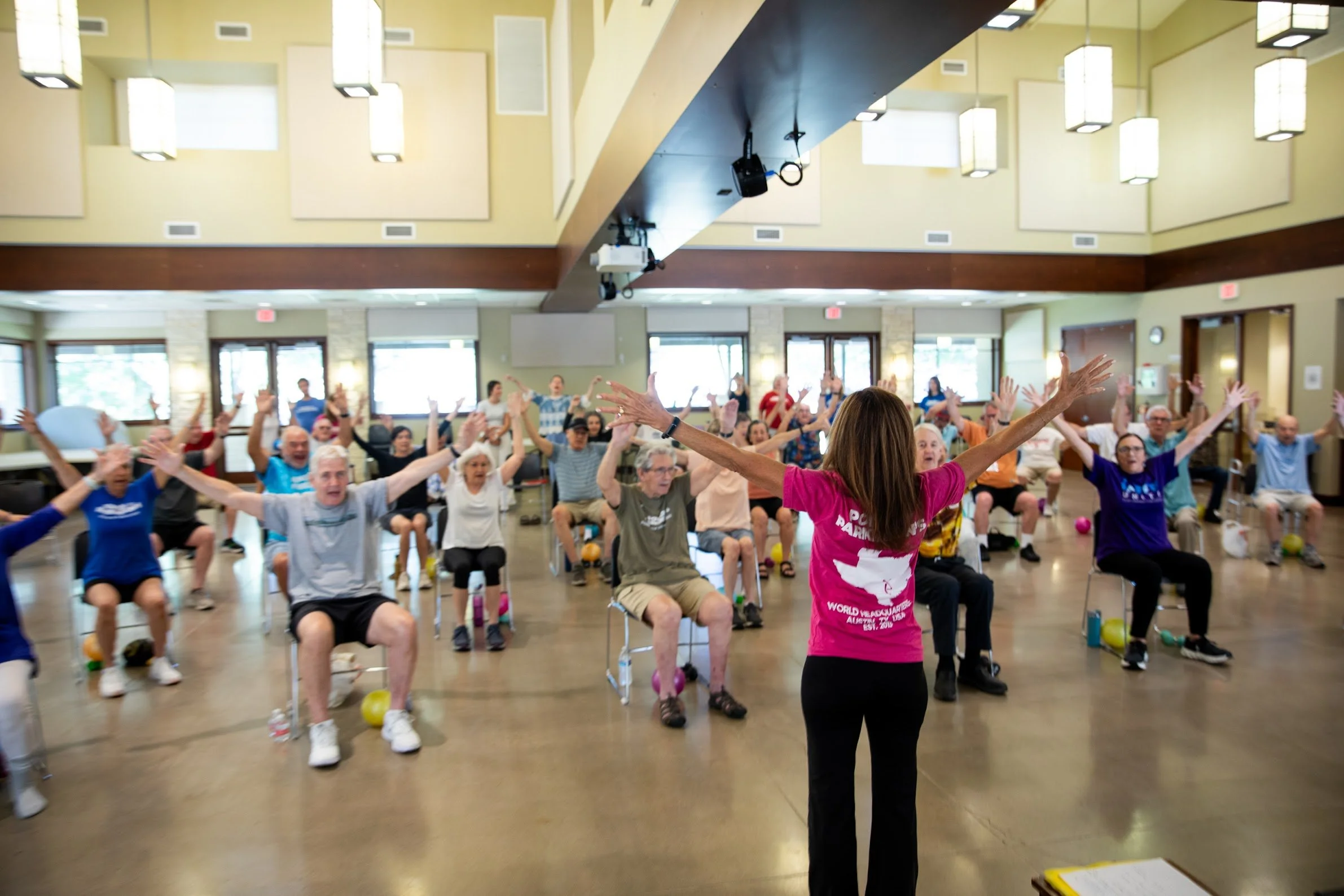
On a more personal level, I’ve seen these benefits firsthand. Participants in my in-person classes show noticeable improvements in gait, agility, balance, and even mental processing. Because of this, I’ve intentionally woven more forced exertion—or high-intensity—elements into my classes.
And the best part? People love it. Regularly, participants tell me they enjoy the challenge and feel better afterward—both physically and mentally.
As someone naturally drawn to cardio-based movement, this shift has been a welcome and energizing evolution in how I teach.
Try out these forced exertion workouts to experience the impact for yourself!